
Understanding Immigration Enforcement Documents – Warrants and Subpoenas
When dealing with immigration enforcement, it is crucial to understand the differences between judicial and administrative warrants. The U.S. Department of Homeland Security has increased its use of administrative warrants and subpoenas to pressure individuals and organizations into compliance. Knowing how to identify these documents can help protect your rights and prevent unlawful enforcement actions.
What is a Warrant?
A warrant is a legal document authorizing law enforcement to take specific actions, such as conducting a search, making an arrest, or seizing property. There are two primary types of warrants related to immigration enforcement:
- Judicial Warrants – Issued by a court and signed by a judge and the date should be recent otherwise it is considered a stale/old warrant that no longer valid.
- Administrative Warrants – Issued by immigration authorities such as ICE or CBP, but not by a court. Tell ICE or CBP to return when they have a valid judicial warrant signed by a judge.
Key Differences Between Judicial and Administrative Warrants
| Feature | Judicial Warrant | Administrative Warrant |
|---|---|---|
| Issuing Authority | A federal or state court judge | ICE, CBP, or USCIS |
| Legal Force | Must be complied with | Does not require compliance |
| Scope of Authority | Grants full legal authority to enter private spaces | Does not grant authority to enter private spaces |
A critical point: An administrative warrant does not grant ICE or CBP the right to enter private spaces, such as homes or non-public areas of businesses, without consent. If a person opens the door, ICE may state that they were given consent to enter the home or non-public areas of the business.
When can ICE Legally Detain Immigrants?
| Warrant Type | Allowed Time |
| Judicial Warrant | 6 a.m. – 10 p.m. (unless a judge has autorized night service) |
| Administrative Warrant (ICE issued) | Any time but they cannot legally force entry into private residences |
| Home Entry | Only with a judge signed judicial warrant |
Home visits and wellness checks: Any agents or those posing as governement agency workers have made visits to homes with the guise of a wellness check. They cannot enter the home wihout a judicial search warrant signed by a judge. Do not consent to their entry.
Subpoenas: Judicial vs. Administrative
Subpoenas are legal documents requiring individuals or entities to provide testimony or evidence. Like warrants, they can be judicial or administrative.
| Feature | Judicial Subpoena | Administrative Subpoena |
| Issuing Authority | A federal or state court judge | ICE, CBP, or USCIS officials |
| Legal Force | Must be complied with | Not immediately enforceable |
| Purpose | Requires testimony or document production for court cases | Used in immigration investigations to gather information |
| Consequences for Non-Compliance | Contempt of court charges | May lead to court enforcement but does not carry immediate penalties |
| Example Document | U.S. District Court Subpoena | DHS Form I-138 |
If served with an administrative subpoena, you are not legally required to comply unless a federal court orders enforcement.
Example of LEGITIMATE Judicial Warrant
For a Judicial Warrant to be valid, it MUST be issued by a court and signed by a judge within the past 14 days.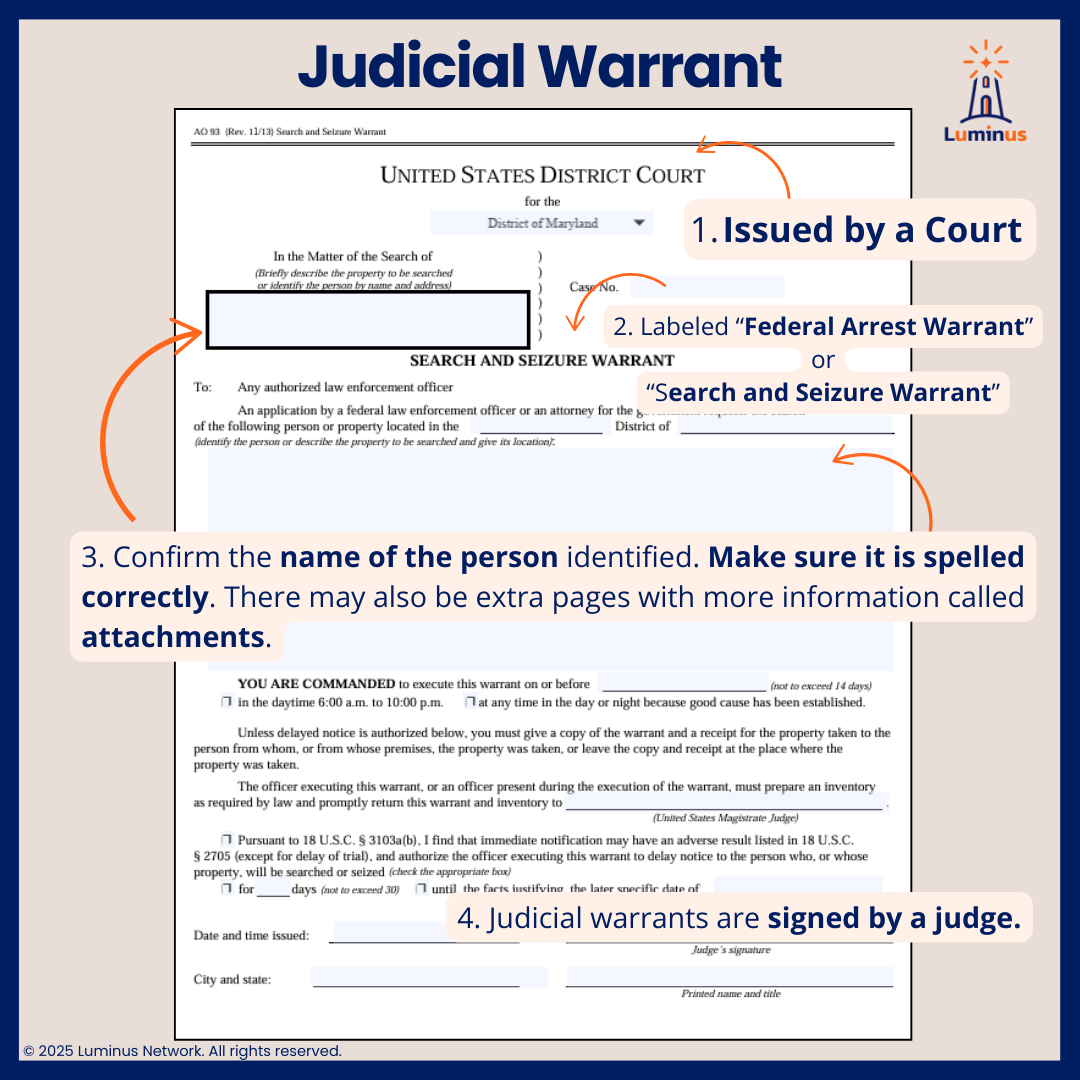
Example of 'Administrative Warrant' - DO NOT COMPLY!
An Administrative Warrant is issued by DHS and NOT signed by a judge.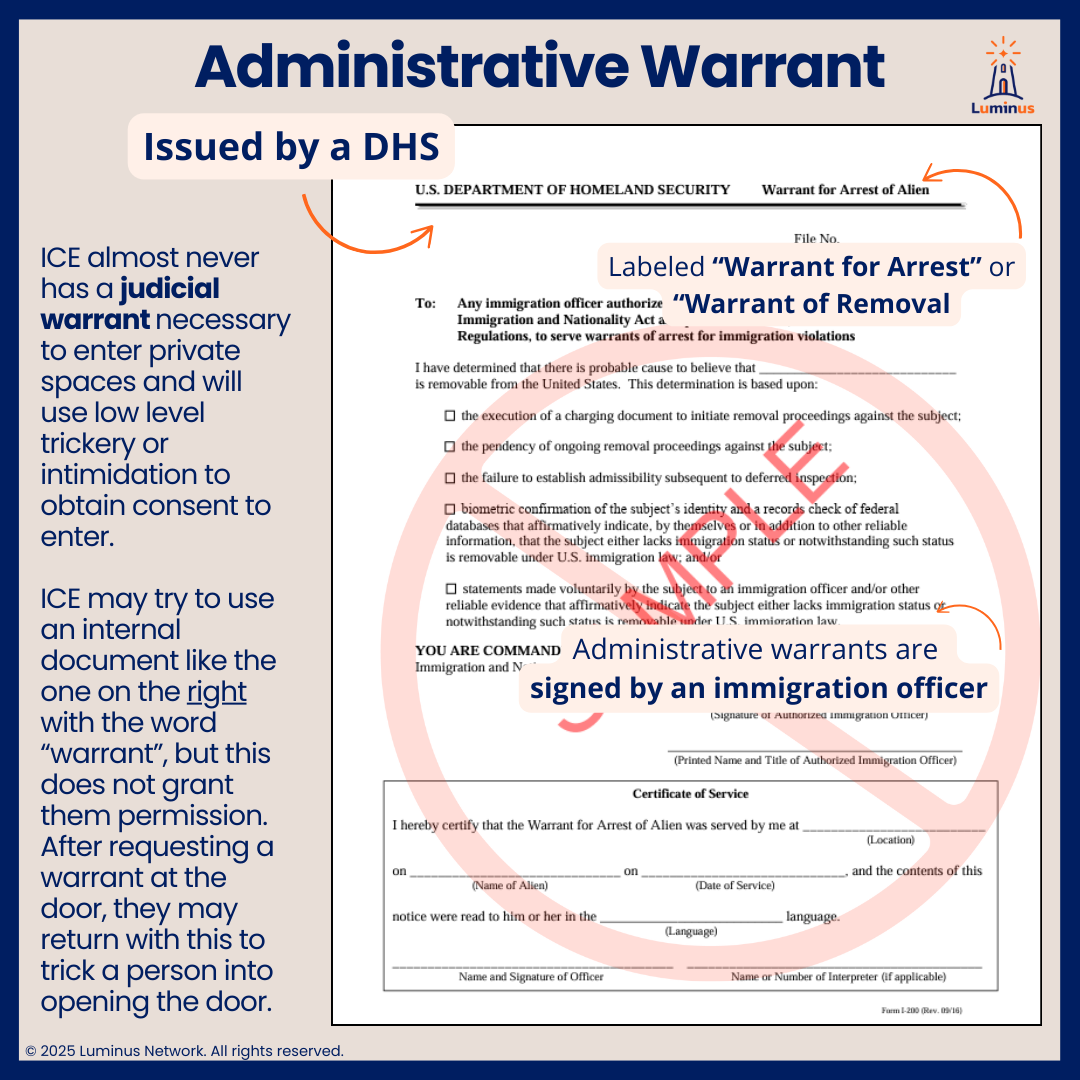
How to Respond If ICE, CBP, or USCIS Comes to Your Door
- Do Not Open the Door – Opening the door can be interpreted as consent to entry. Ask the agents to slide any documents under the door, show them through a window, or present to doorbell camera.
- If you have an attorney – Contact your attorney and, if needed, put them on speakerphone to communicate with ICE through the door.
- Examine the Document Carefully – Determine whether it is a judicial or administrative warrant.
- If it is a judicial warrant, verify that it is signed by a judge, correctly names the person or location, and is within the execution timeframe.
- If it is an administrative warrant, you are not required to comply and may refuse entry.
- If it is a judicial warrant, verify that it is signed by a judge, correctly names the person or location, and is within the execution timeframe.
- Remain Silent – You have the right to remain silent. Do not answer questions about your immigration status or provide any information beyond what is legally required.
- Do Not Sign Anything – Avoid signing any documents presented by immigration officers without first consulting an attorney.
- Document the Encounter – Take notes, record video (if legally permitted in your state), and collect badge numbers or names of the agents.
- Seek Legal Assistance – Contact an immigration lawyer or advocacy organization immediately for guidance.
What If ICE Agents Refuse To Show ID Or Take Off Masks?
According to the ACLU, you can deny entrance even with a warrant the agent shows identification when asked.
You can ask an ICE officer to remove their mask during an encounter or before entry, but they are not legally obligated to do so.
ICE Stance: ICE leadership has stated that agents can continue to wear masks in the field, citing safety concerns and threats against officers.
Identification Alternatives: ICE states that agents wear badges and carry credentials with their name and organization, and identify themselves as immigration officers during an arrest or as soon as it is practical and safe.
Protecting Students Against Administrative Immigration Warrants and/or Immigration Subpoenas
Each school has leadership such as principals that should obtain copies of documents and enough informaiton to forward to their central school district’s office to make a determination on next steps if ICE attempts to detain a student. If presented with an administrative warrant or immigration issued subpoena, school deny access to the student and argue compliance with Family Educational Rights and Privacy Act (FERPA). Parents and any emergency contacts should be notified as well from the student’s file.
Protecting Your Rights in Houses of Worship
Houses of worship have historically served as places of sanctuary and support for immigrant communities. While ICE and CBP may attempt enforcement actions in religious institutions, they are still bound by constitutional limitations. Without a judicial warrant, ICE agents cannot enter non-public areas of places of worship. Religious leaders and congregations should be aware of their rights and prepare a response plan, including designating a point of contact, educating members on legal protections, and forming networks with legal advocates to challenge unlawful enforcement actions.
Protecting Your Rights in Health Care Facilities
Under recent policy changes, ICE and CBP can conduct enforcement actions in hospitals and clinics. However, healthcare staff and patients still have rights:
- ICE agents need judicial warrants to enter private patient areas.
- Staff should designate a point of contact to handle law enforcement interactions.
- Facilities should clearly mark private areas to prevent unauthorized entry.
- HIPAA laws protect patient information from being disclosed without a judicial warrant or court order.
Take Action: Be Prepared
- Know Your Rights – (English or Spanish version) Learn how to distinguish between judicial and administrative documents, 4th, 5th, and 6th Amendment Rights, and various other areas to protect yourself and others in the community.
- Train EVERYONE including Staff, Community Leaders and Members – Educate those around you on how to respond to enforcement actions.
- Establish a Response Plan – Work with attorneys to create policies for handling ICE and CBP interactions.
- Some good sources for creating plans:
- Engage in Public Advocacy – Pressure local governments to adopt sanctuary policies and push back against aggressive enforcement tactics.
- Find Legal Help – Contact Luminus or search Immigration Advocates Network for immigration legal nonprofits in your area.
Find Printable Window Signs Here:
https://indivisibleknoxville.org/printable-window-signs/